Showing posts with label Travel Philippines. Show all posts

Monday, April 16, 2012

Friends make time for Nes Jardin

I don’t even remember the last time I danced this much,” a girl friend said, in between huffing and puffing. Me, too.
Must have been in the ’80s and the ’90s, we all said, but then we also went further back in time, to the ’70s or even the ’60s, when the band named Daddy Cool struck the irresistible disco hits of those eras.

Who were we to play coy? (Do the twist? We were still in school when everybody was doing the twist, not quite partying yet, but hey, we were already around in that era. No denying that.)

About four weekends ago, a bunch of friends—very busy people, really—put their hectic schedules on hold, hopped on a yacht and sailed to Batangas, to spend the weekend in the grand nature sprawl that is Pico de Loro, just bonding, eating, swimming—and dancing.

And all this for the love of Nes Jardin.  After all, the former president of the Cultural Center of the Philippines (CCP) is turning 60 only once—and is happily proclaiming it. Nes celebrates his birthday with friends every five years, and last March 3 was the fifth year from the time he marked his birthday at a dinner at Mandarin’s Tivoli hosted by good friend Nedy Tantoco, Rustan’s president.
From his long stint in the ’80s at the helm of Ballet Philippines (with dance icon Alice Reyes) to his recent term as president of the Cultural Center of the Philippines, Nes has not only made a difference in the culture and arts scene; his long CCP tenure had also been one of stability, collaboration with various sectors and many milestones.

In a quarreling sector like the culture scene, he was able to work with practically everyone; he didn’t make enemies, but instead gained friends and expanded the network of support for CCP.

It was no surprise, therefore, that friends would readily mark his birthday on their calendar. This year, way before March 3, Nes already alerted his good friends to keep the first Saturday of March open for a swing to Pico de Loro where his friend of many decades, Betty Sy, would be hosting our stay.

His friends promptly gathered early Saturday morning at the dock in MOA, raring to get awakened and revived by the sea air. As soon as the yacht set sail, Italian Ambassador Luca Fornari and his chic wife Silvana laid themselves out in the open deck to bathe in the sun while we Pinoys, you guessed it, sought cover from the scorching sun. But it was glorious weather—enjoyed with even more glorious company.

Among them were National Museum director Jeremy Barns, filmmaker Loy Arcenas, diehard travelers Susan Medina and Edu Jarque, Rustan’s Marilen Valbuena, Singapore Airlines’ Rita Dy, Lifestyle Asia’s Anna Sobrepeña who came with daughter Mica, Bridges’ Annie Ringor, Glenn Gale, Joseph Calata, and former CCP head Bal and Tessie Endriga. Mr. Endriga, supposedly retired, has a project up his sleeve.

Also there were Nes’ friends Wally Baynes, and Dave and Mia Kauffman with their tiny brood. Dave is one hunk of a father I’ve seen who cradles in his beefy arm his and Mia’s newborn daughter, to bottlefeed her, at mealtimes. (This must be in between Mia’s breastfeeding.) The father-daughter sight is so (equal-gender) now—must be the Madonna and Child version of this postmodern era.

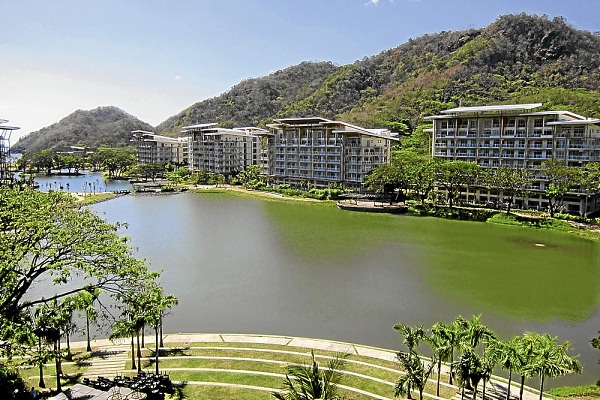
Betty Sy and sister Tessie Sy-Coson welcomed the party at Pico de Loro, the fast-moving coastal development of SM in Nasugbu, Batangas. It was surprising to see a sizable weekend community already forming. It has been quite a transformation since the last time we were there years ago, when its beach club was newly launched.

The mid-rise condominiums already have a good occupancy—evident from the vehicles filling up the parking slots. The development has a country club with food and beverage outlets, amenities such as a beautifully designed swimming pool, tennis court.

The Pico de Loro Hotel has well-appointed rooms, with balconies where you can sit back and enjoy the view of the expansive lake, the rest of the concrete development, and the natural terrain beyond it.

13 coves
But the strong draw is the Hamilo Coast with its 13 coves, which must be the largest coastal development in Batangas. Pico de Loro settlers love to take the boat ride to any of these coves and spend the day there, in blissful solitude, swimming on the beach, snorkeling or doing other water sports, or just sleeping on a hammock under the coconut tree.

Sleeping on a hammock under the tree—that’s one thing that hasn’t been on my to-do list for a long time. After a bad-sleep Friday, I did just that the moment the group docked in Santelmo cove, one of the lovely beachfronts in the Hamilo Coast. While everyone snacked and chatted in the sand, under a canopy of trees, I had a good nap, a prelude to wading in the waters at sundown.
Back in the beach club, for dinner, the main dining hall was decked in drop-dead glamour white. The walls and high ceilings were covered in gossamer ecru muslin lined with capiz shells. Since all of Nes’ guests were asked to come in white for the dinner, the scene was simply elegant minimalism, with the candles at the table centerpieces providing the glitter.

Even the buffet spread blended with the stark white composition—except for our favorite, the lechon.  Aside from the roasted pig whose burnished brown color stood out in the all-white canvas that was the dining hall, also a hit was the halo-halo station.

The Italian ambassador and his wife aren’t only so attached to the Philippines, they’re also among the best promoters you could have for the country. They’ve been all over the islands, from Bohol (which they love for the diving and the history) to Palawan. Fornari told us about how he was told by other Italians, particularly Italian missionaries and priests, and businessmen, based all over the country, how conditions have improved, particularly in doing business. The bureaucratic red tape and corrupt practices have been reduced at least.

It shouldn’t be surprising if the couple would choose to spend part of their retirement years in the Philippines.
After dinner, Betty had everyone trooping up to the Brissa Bar on the roofdeck for some burning-of-the-lechon calories dancing to the retro sounds of Daddy Cool. This turned out to be some letting-your-hair-down till way past midnight. Everybody shook his bootie, including acclaimed filmmaker-designer Loy Arcenas who was the first to hop onto the line dancing; everyone, except museum director Barns. It warmed your heart to see Tessie Sy-Coson—on the Forbes list of power women—unwind and dance. Very rare moment.

We would learn later that the day before we left for Pico de Loro, Nes resigned as head of Cinemalaya, the indie film body he helped steer to mainstream success. But not many knew, not even media—that was typical of Nes not to draw attention to himself.

With or without Cinemalaya, anyway, Nes, on his 60th birthday, was given a very precious gift by his friends—the gift of time.  They chucked their toxic scheds to be with him.

Remembering Bibot
Over at Onstage Greenbelt, we enjoyed Repertory’s musical “Jekyll & Hyde” (Michael Williams and Cris Villonco) one Saturday evening, and that same evening, after the performance, we witnessed how these exceptional theater artists have a gift, other than their artistry, and that’s the gift of remembrance.

Repertory stalwart Joy Virata (who’s doing “Care Divas” in April, by the way) strode up the stage to announce that Repertory is marking its 45th year by paying tribute to its great founder “Bibot” Amador and its great director and actress Baby Barredo. (Bibot’s birth anniversary was last February 7.)

Joy called a surprised and very touched Barredo onstage. Baby, even on the impulse of the moment, displayed a performance-worthy impulse. She spoke words of remembrance and gratitude, sang a few notes from the musicals so associated with her, and one by one, the men of Rep (then and now) emerged onstage to sing to her—from Audie Gemora and  Miguel Faustmann to Freddie Santos. They all remembered how Repertory changed and shaped their lives, and were all there to mark that remembrance.

To end the tribute, Baby enjoined everyone, who had been and continue to be part of Repertory, in whatever capacity, to hop onstage and sing. The theater was almost full.  When everyone did go onstage, including “Miss Saigon’s” Leo Valdez and devoted publicist Toots Tolentino, the theater was only half-filled. That proved how many considered Rep to be a part of their lives.

I remember how Bibot loved to recall how they began at Insular Life building. They would perform to an audience of five, one of them Bibot’s driver.

Travel Philippines

Saturday, April 14, 2012

Escape to (or from) White Beach

About six years ago, I wrote a piece on Puerto Galera.  I was in love with a French intern in Tabinay, and my article was peppered with lines like “a sea as blue as Paul Newman’s eyes,” and dreamy voyaging and sap and wanderlust.

I remember hiking to Mangyan Village with this long and exquisite creature, and on the way up stopping to squat upon a rocky precipice, our exchange on solar panels punctuated every now and then by the buzz of chainsaws.

It was April, the height of mania and knocking back plastic mugs of Mindoro Sling (Tanduay rum, Gina’s Mango Nectar, Sunny Orange, Sprite, Grenadine, and calamansi, but versions vary) on White Beach, and I wanted nothing to do with it. By then, waking up sandy and disoriented beneath somebody’s henna booth had long ago lost its appeal.

I’d regularly been going to Tabinay, a quiet portion of the mainland, with family members since I was little, but it was only on my last summer of college, in the early 2000s, that I found myself disgorged upon the expanse of white sand and wooden bars and vendors of yarn anklets that is White Beach.

I was among a pack of people who believed themselves Rastafarians, and during the day we battled waves and went around cliffs and claimed for ourselves spots of spectacular and solitary nature to spew out discourses on important matters such as the origins of “4.20.”

At night we pitched tents and dug ourselves into holes and crawled to and fro Coco Aroma, a jungly bar near the end of the beach, in exaggerated praise and awe of the night sky and all that it is. It was the last time White Beach would allow tent pitching on the sand, and the last time the beach would be free from police patrols and insane crowds in the summer.

Rock barrier

I would return to the island 10 or 15 more times, sometimes choosing the quietest of seasons, sometimes smack in the middle of tourist free-for-alls.  At times I crossed the rock barrier at the end of the beach to stay at resorts in Tamaraw, where rooms are slightly more expensive but the air less frenzied. Sometimes I rented out Coco Aroma’s attic for P200 a night, where your head hits the ceiling when you try to sit up. And sometimes I went along on trips to Sabang, a small island that resembles Makati Avenue at night, except it’s surrounded by water.

Now, most people my age have moved on to more advanced levels of Beach, but I’ve always kept my kinship with Puerto Galera. Its smell and colors, Bob Marley soundtracks, and cold bottles of Pale Pilsen drank upon awry wooden stools are now all synonymous to summer, and the efficient discharge of city toxins without ever worrying about paying too much for anything.

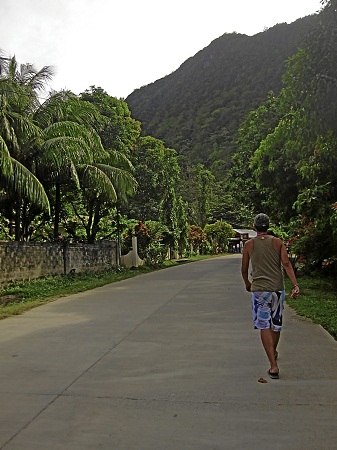
This year, I convinced my cousins to take the two-hour bus to the Batangas pier and ride the hour-and-a-half ferry to Puerto Galera. We agreed to avoid White Beach at all costs, and opted for a quiet little resort in Talipanan near Tamaraw beach.

As usual, the Batangas port was filled with people trying too hard to be helpful, but I’d grown used to them and instead of lashing out, now just allowed myself to be steered towards different windows for whatever transaction. The ferry ride was nice as always, except the part where they unfurled plastic sheets to keep passengers from getting wet. Then it got seriously stuffy and children began to look wildly around for places to hurl. Thankfully, we arrived at our destination without incident.

Unremarkable

Talipanan is an unremarkable area that is just starting to develop, and we were content. Apart from the occasional spiel by vendors/masseuses/enthusiastic tour guides, we mostly had the beach to ourselves. We switched from languishing on the sand with our books and oils, and venturing into the ocean to flop around and lie on our backs. We spent a glorious afternoon baking under the sun and munching on buko meat and trying to keep our mats from flying off the sand. By the second day, we were on a tricycle headed towards White Beach for P20 each.

The best thing about Puerto Galera is that there is always a way to escape from the madness—or to choose to go towards it. There are always peaceful coves and niches of space you can carve out for yourself, and jungles and mountains and side streets to retreat to. The island is filled with bays and smaller islands and stretches of sand and sea.  And should you decide you’re done with meditating, there is always crazy ol’ White Beach to return to, with its pitchers of Mindoro Sling, packs of vendors foisting their balut at you, and the motley yet all-too-familiar crowd of tourists, foreigners, locals, dogs, and legends.

By the time we were done with our Mindoro Sling, bars on the beach were starting to crank up their techno, and excited, mostly younger groups were beginning to flock towards the noise. We took this as our cue to hail a trike back to Talipanan.

As I had already said, waking up on the sand—either from extreme drunkenness, or just to avoid having to pay for accommodations—is so early 2000s.

Note: P1,000 is no longer enough to fund a weekend, as the common breakdown—P500 for round trip transportation, P200 for accommodation, the rest for beer—no longer holds.  Also, the port has sadly found ways to charge extra for things never properly explained, but rates remain reasonable and far from Boracay-esque.

Contact the author at shahooondog@yahoo.com.
Travel Philippines

Wednesday, April 4, 2012

AirAsia’s all-in low fare promo for summer

MANILA, Philippines—AirAsia, the country’s newest low cost carrier, further heats up competition in the local airline industry with its “red hot” all-in promo fare of only P799 one-way for Clark-Kalibo (Boracay) and Clark-Puerto Princesa (Palawan) routes.

AirAsiA also offers an all-in low fare of only P999 one-way for the Clark-Davao trip.

Its “red hot” all-in promo of P799 for Kalibo and Puerto Princesa and P999 for Davao includes base fare, fuel surcharge, processing fee and government mandated fees such as aviation security fee and value-added-tax, the airline said in a statement on Tuesday.

The promo period will be from April 2 to April 8, 2012 and guests will be able to travel from April 10 to July 31 2013 with these all-in fares which are available online at www.airasia.com, via mobile at mobile.airasia.com and via AirAsia applications for Blackberry, iPhone and Android phones.

“Summer Philippines is now more fun with AirAsia’s awesome connectivity,” AirAsia’s chief executive officer Maan Hontiveros said.

“Local and international tourists now have easy access to Philippine’s hot destinations such as Pearl Farm in Davao, Boracay beach and  the famous Puerto Princesa Underground River in Palawan,”  Hontiveros  added.

AirAsia’s new service to Puerto Princesa from Clark, the statement said, will provide the accessibility to visit Calauit Island Wildlife Sanctuary, The Coron Reef, Tubbataha Reefs National Marine Park, the famous Puerto Princesa Underground River, which has been voted as one of the seven wonders of nature.

Travel Philippines

Tuesday, March 13, 2012

Is Puerto Princesa’s tourism boom sustainable?

The tourism onslaught on Puerto Princesa is on.
Tourists are everywhere.  One out of every three vehicles on city streets is a van packed with tourists, crawling behind tricycles buzzing around like flies.
Although Puerto Princesa already buzzes with tourists these days, the city is still gearing up for an expected increase in arrivals.
Constructions of new tourist facilities are going on simultaneously all over the city that the dust has no time to settle.  Rapid change is everywhere; the city is aggressively in expansion mode.

Already evident are the traffic, urban congestion and visual chaos that follow the rush to build up a city known to be the greenest in the country.

Puerto Princesa nowadays has that boomtown feel.  The city is changing right before your eyes, and in a year or so it will be practically unrecognizable.

That is true:  Less than a decade since my last visit there, it was difficult for me to find the Puerto Princesa I remembered.

The Puerto Princesa I knew was a quiet city that had so much personality, a welcome and very unique identity distinguishing it from other Philippine cities.  Unlike in other congested cities across the country, in Puerto Princesa fully grown trees shaded its broad main avenues, a perfect green foil to the low-rise structures along the streets.

Those endangered avenues are harder to find now.  New development is homogenizing the look of the city, soon to look like all other newly developed areas in any other Philippine city where one-strip mall after another lines streets with no sidewalks and no trees.

Unless strict planning and zoning controls are instituted, the unique Puerto Princesa identity that sets it apart from any other place in the country and that makes the city a tourist attraction will be gone.
Aside from allowing maximum development to happen in a regulated manner to prevent overdevelopment, zoning and planning measures control traffic, pollution; and while allowing the city to grow, control measures maintain growth at sustainable levels.

Essential

Determining and maintaining sustainable levels to effectively manage tourism growth are essential to keep alive the goose that lays Puerto Princesa’s golden eggs.  The goal is to sustain rather than deplete tourism resources.

Puerto Princesa’s Subterranean River, the city’s  prime tourism resource, is already close to becoming a victim of its success.

Reports by the city state that the Subterranean River expects 625,000 visitors in 2012, an increase of 100,000 from 2011 levels; and the projected increase by 2016 is to approach the two-million mark.

The question is, How can the Subterranean River sustain the projected increase in visitor arrivals?
The number of visitors to the Subterranean River is strictly regulated through required bookings, and strict registration procedures document visitors before entry.

To avoid overloading, passenger numbers are strictly regulated in boats ferrying visitors from the pier to the mouth of the Subterranean River, and in the smaller boats to which visitors transfer to enter the river grotto.
Inside the Subterranean River, a constant train of boats goes in either direction.  At the present rate of visitation, it is evident that carrying capacity for the cave is close to maximum and that alternatives are needed if more arrivals are expected.

Human impact
Another question needs answering here:  What is the human impact on the grotto?

How does the increased carbon dioxide from human exhalation impact on the ecosystem balance within the cave?  Already we are told that the number of bats living in the cave have decreased, an indication of a change in the ecosystem balance within the cave.

Humans introduce lint that flies around, attaches to the cave walls, and impedes the natural formation of stalactites and stalagmites.  Think of how much lint an average of 45,000 humans who enter the cave per month can give off.  How do the rock formations combat lint?
These are just a few environmental-and-tourism management issues that should be answered through a comprehensive planning process that gives direction to the growth of Puerto Princesa while sustainably managing its tourism resources.

It being a site inscribed on the prestigious Unesco World Heritage List in 1999, a Management plan to protect and guide all impacts in the entire Puerto Princesa Subterranean River Park is what the city  is committed to.

Being inscribed on the World Heritage List requires managing and maintaining the natural equilibrium of the park, assuring its sustainability and its future, while allowing tourists and visitors to enjoy its natural beauty.
The tourist buzz is expected to bring more benefits to the Puerto Princesa community, and it should.

However, unless sustainability guides the tourist boom, in the end the benefits could turn out to be not only short-lived, but also harmful to the city’s tourism assets, providing only temporary relief for the community.
Tourism is normally double-edged:  beneficial when well-managed, and disastrous when tourism assets are exploited.

If not hatched sustainably, those golden eggs may turn out not be golden in the long run.
E-mail feedback to pride.place@gmail.com.
Travel Philippines

Monday, March 12, 2012

Say Hola! to Sun Life’s Shine Big in Barcelona contest

Learn how to tango. Unearth the secrets to a mouth-watering paella. Marvel at the beauty and magnificence of La Sagrada Familia.

This year, Sun Life bgFinancial-Philippines (SLFP) brings together the alluring Catalan culture and the rewarding career of a financial advisor through its “Shine Big in Barcelona” promo.

Digital, shared experience
Shine Big in Barcelona is a digital contest that one may win via Sun Life’s official Facebook page (www.facebook.com/sunlifeph). Simply refer five friends whom you think may be interested in a career with Sun Life, their valid email addresses to earn one raffle entry. The contest runs until March 30, 2012.

The annual Shine Big campaign wants to bring the benefits and opportunities of being a Sun Life financial advisor closer to Filipinos. Last year, one lucky winner was able to enjoy the city that never sleeps – New York – while also getting to know the many possibilities that the profession offers.
Worthwhile, fulfilling career

“Being a Sun Life Financial advisor is a rewarding career in itself — it allows one to help Filipinos achieve financial security,” says Mylene Daez – Lopa, Chief Marketing Officer of Sun Life Philippines.

“We also reward our advisors with incentives that are experiential, such as trips to exciting destinations, here and abroad. This campaign aims to share with the public what one can get from shining with Sun Life Financial.”

Sun Life financial advisers enjoy the freedom of determining their own work schedules, allowing for family and personal time.

Unlimited earning potential is also possible, as their earnings are commensurate to how hard they work. More than incentives such as trips around the world, being a financial advisor is a noble profession, one that can make a difference in the lives of countless Filipinos.

Fulfill your dreams to see Spain while also reaching for your bigger and brighter goals. Help people plan for their future while also enriching your present. For more information about Shine Big, visit www.sunlife.com.ph or call 8499888.

Travel Philippines